Hollow Macarons: Why Your Shells Are Empty Inside and How to Fill the Gap
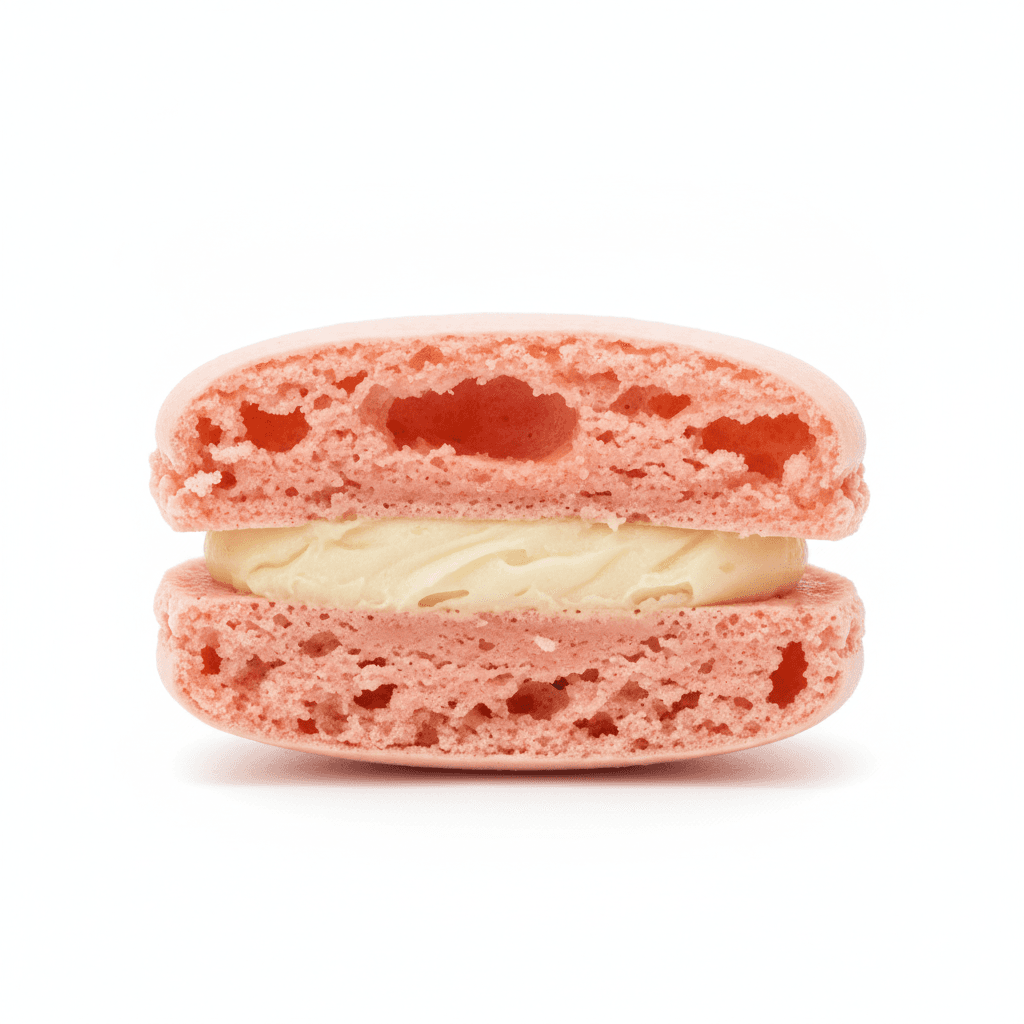
Cut open your macaron and instead of a tender, slightly chewy interior, there's a cavern — a big air gap between a thin top shell and the bottom. Hollow macarons are the second most common macaron defect after cracking, and they're maddening because the outside can look *perfect*. Here's how to figure out which of the usual suspects is robbing your shells of their insides.
What "Hollow" Actually Means Structurally
A proper macaron shell is a meringue foam stabilized with almond flour and sugar. During baking, the interior should cook into a moist, marshmallow-like crumb as steam gently inflates then settles. A hollow shell means the top crust set and rose, but the interior structure collapsed or never formed — leaving the crust suspended over nothing. Everything that causes hollowness is something that either weakened the interior structure or set the exterior too fast relative to it.
Cause 1: Over-Whipped Meringue
Counterintuitive, but true: meringue whipped too stiff is a prime hollow-maker. Over-whipped whites create an overly rigid foam; the top crust firms up almost immediately in the oven, and the shell rises as a balloon with nothing beneath it. Fix: whip to firm-but-glossy peaks — the peak should stand up but still look smooth and shiny, not dry or clumpy. If your meringue has started to look grainy, it's gone too far.
Cause 2: Oven Temperature Too Low
This one's the surprise for most bakers. When the oven is too cool, the shell heats slowly: the interior never gets the burst of steam expansion that creates proper crumb, the shell sets gradually, and you get a gap. Hollowness plus wrinkled tops and no feet = low oven. Fix: get an oven thermometer. Most hollow-shell cases we troubleshoot trace back to an oven running 20°F under its setting. Try 300–315°F true temperature and adjust from there.
Cause 3: Over-Mixed Batter (Macaronage Gone Too Far)
Over-mixing deflates the meringue. The batter spreads too much when piped, bakes into thin, fragile shells with frilly spread-out feet — and often hollow tops, because there's not enough foam structure left to form an interior. Fix: stop folding as soon as the batter ribbons off the spatula and a figure-8 test passes. If your piped shells spread wider than your template in the first minute, you've gone too far — and on the next batch, fold less.
Cause 4: Resting Too Long (Yes, That's Possible)
Over-rested shells — left out for hours, especially near warmth — can develop too thick a skin. The skin sets hard in the oven and the interior, unable to expand upward, separates from it. This is less common than under-resting, but it happens in warm kitchens where bakers rest "to be safe." Fix: rest until touch-dry, usually 30–60 minutes, then bake promptly. If your schedule forces a delay, hold piped trays in the fridge, loosely covered, rather than a warm counter.
The Maturity Question: Hollowness Can Fix Itself (Sort Of)
Here's the grace note: filled macarons mature. After 24 hours in the fridge, moisture from the filling migrates into the shell — and mildly hollow shells often collapse gently onto the filling and become pleasantly chewy. Severely hollow shells (a thin lid over a void) will crack when bitten. So grade your batch: slight gap = fill and mature; full cavern = baker's snacks. This is also why we mature every batch for a full day before selling at the shop — texture is everything.
Your Diagnostic Checklist
Run through in order:
- Verified your oven temp with a thermometer? (Fixes most cases.)
- Meringue glossy or grainy? Grainy = over-whipped.
- Did shells spread after piping? Yes = over-mixed batter.
- Rested longer than 90 minutes? Consider over-resting.
- Hollow + no feet + wrinkled skin? Nearly always low oven temp.
Change one variable per batch. Macarons punish multi-variable experiments because you can't tell which change worked.
Still chasing the perfect crumb? Grab a box of our macarons as a control sample — nothing calibrates a home baker like tasting the target.