How to Fix Hollow Macarons (The Stubborn Case Files)
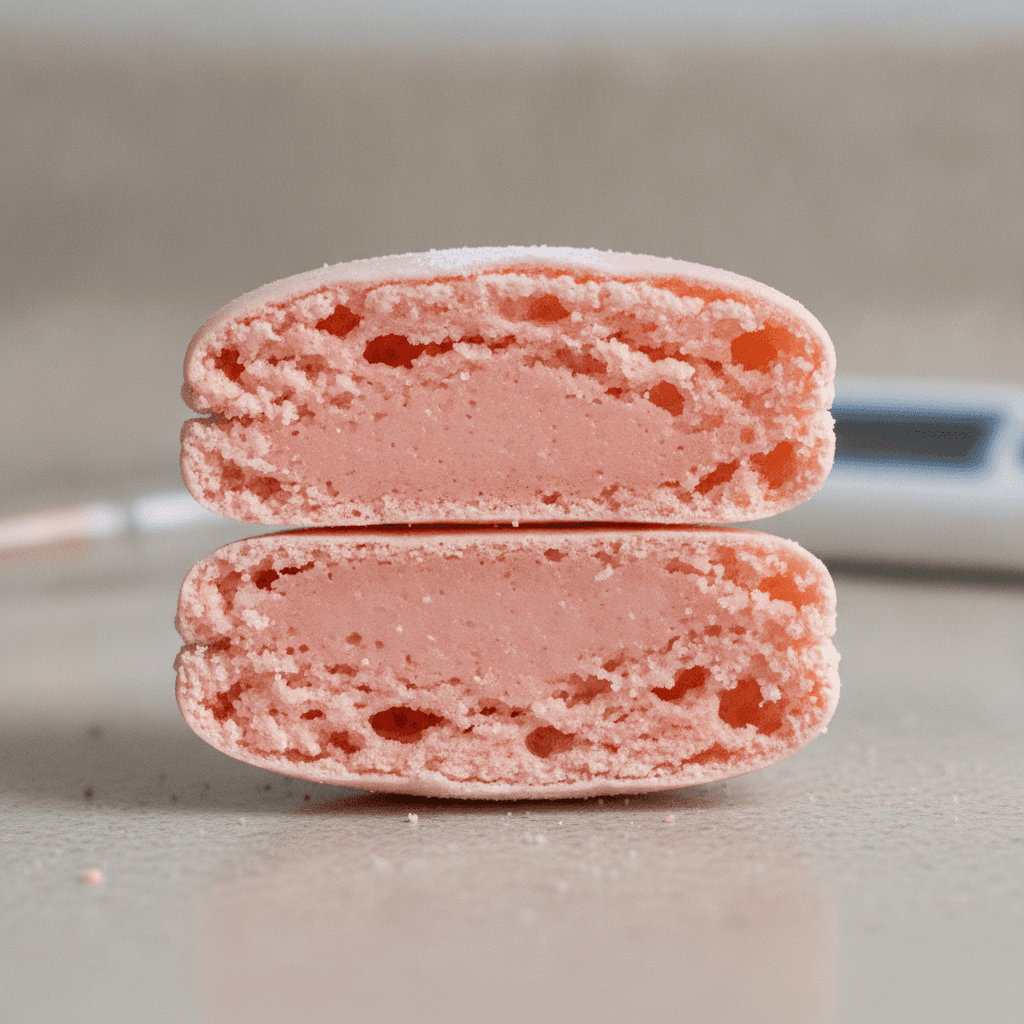
Our first hollow-mac guide covers the big three causes (over-whipped meringue, oven too hot, under-rested shells). But the question we get most is: 'I did all that and they're STILL hollow.' This is part two — the advanced case files, for bakers whose hollows persisted past the standard protocol.
Case File 1: Oven Hot Spots (The Sneaky Standard Culprit)
Every oven has hot spots; in most ovens, the rear corners and the side nearest the heating element run 25–40°F hotter than the set temp. Macs in the hot zone hollow while the rest don't. Diagnose: bake a tray of 12 and note *where* the hollows sit — pattern = hot spot, random = other cause. Fix: rotate the tray 180° at minute 7 (after feet set); move the rack one position away from the element; or map your oven with a tray of white bread once (the toast color map is your hot-spot map, permanent and free).
Case File 2: Almond Flour Grind and Fat Content
Overly-coarse almond flour (visible flecks, gritty feel) traps air pockets that expand into voids — the shell sets a smooth ceiling over a cavern. Diagnose: rub flour between fingers; sandpaper-gritty = suspect. Also check rancidity (the freshness guide) — oxidized fat changes batter behavior and correlates with hollows in our tests. Fix: re-blend coarse flour in a food processor with the powdered sugar in short pulses (10 x 1-second pulses, stirring between), sift again, discard the coarse tail. Yes, sifting twice. The shells will tell you it was worth it.
Case File 3: The Over-Whipped-Italian Meringue
In the method post we said Italian is forgiving — mostly true, with one failure mode: once the syrup streams in and the meringue reaches stiff, KEEP whipping past that point and you build a meringue so aerated and dry that the batter can't release its air during macaronage — hollows follow even with perfect everything-else. Diagnose: feel the cooled meringue — if it's dry/cottony rather than glossy-marshmallow, this was it. Fix: after stiff-glossy, STOP. The bowl should still feel slightly warm (110–115°F) — whip no further once temp drops and stiffness arrives.
Case File 4: Under-Baking (The Surprise)
Everyone knows over-baking hollows; under-baking does too, differently — the shell's interior structure never sets, so it collapses away from the top during cooling, leaving a void. Diagnose: hollow macs with slightly sticky interior walls and tops that wrinkle the next day = under-baked hollows. Fix: the wobble test — nudge a shell at bake-end; if it slides on its feet rather than moving as one body, 2 more minutes. Then cool fully on the pan before peeling.
Case File 5: Resting-Related (Humidity Version)
In high-humidity kitchens, shells skin over *too slowly* — the exterior never dries enough before baking, so steam escapes through the top early rather than lifting from the base, and the interior separates. In very dry kitchens, the opposite: skin forms so hard and fast that interior steam concentrates and blasts a void. Diagnose: how long did the skin take to be finger-dry? Under 20 min (too-dry) or over 75 min (too-humid) = suspect. Fix: humid — the fan trick, AC, bake smaller trays. Dry — skip the fan, monitor closely, pipe slightly thicker.
The Full Diagnostic Script (Use It In Order)
- Note WHERE hollows were on the tray → hot spot test (Case 1)
- Feel/chew a hollow shell — gritty? → flour (Case 2)
- Recall meringue texture — dry-cottony? → over-whip (Case 3)
- Interior walls sticky? → under-bake (Case 4)
- Recall rest-time → skin timing (Case 5)
- If none fit: change ONE variable, log the result, and treat each batch as an experiment with notes. The macaron journals of consistent bakers all look like lab notebooks — that is not an accident. For the fully-calibrated reference: order a box and compare textures side-by-side — it's the diagnostic baseline pros use too.
Persistent hollows always have a persistent cause — run the case files in order, log everything, fix one variable at a time. And the bakery box is the control group.