How to Macaronage: The Fold Count Is a Lie (Here's the Real Test)
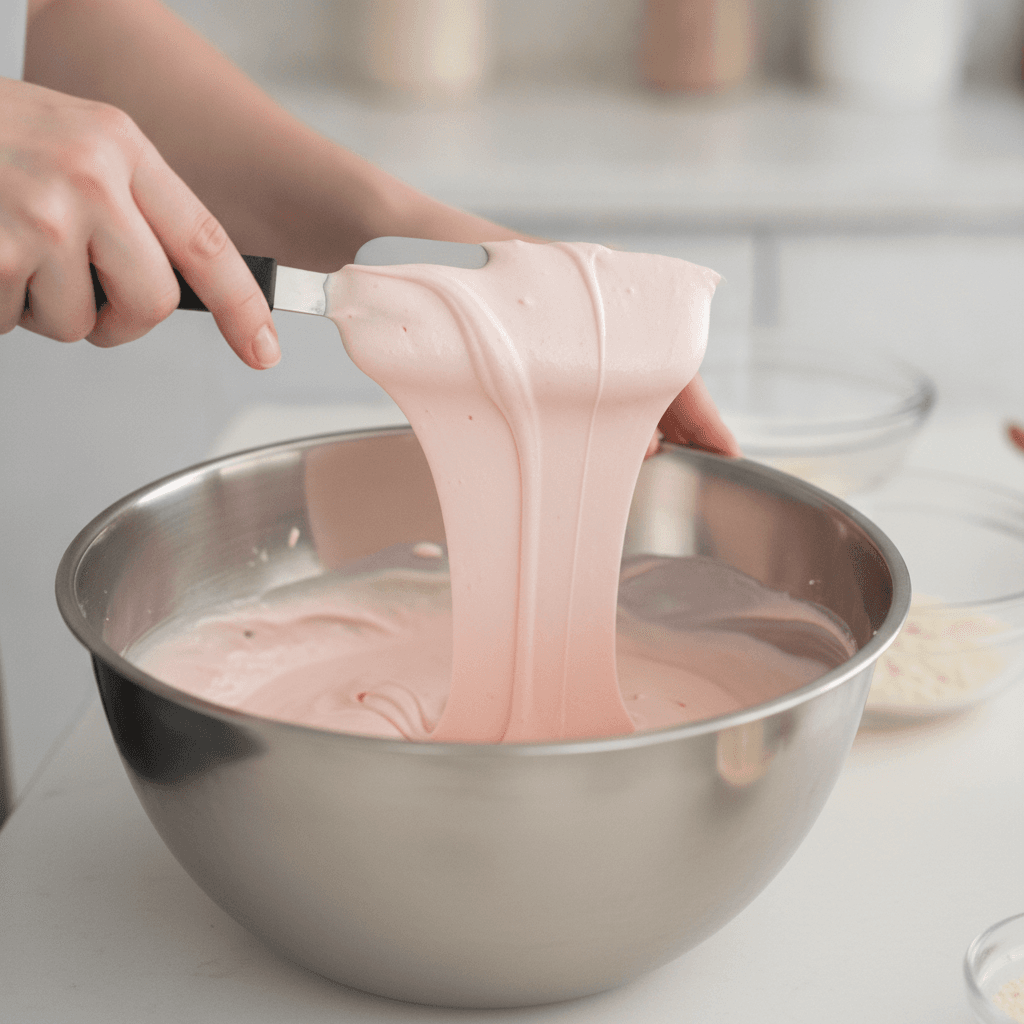
'Fold 40–50 times' — every beginner macaron recipe says some version of this, and it's nearly useless, because fold count varies with batter humidity, your folding aggressiveness, and the almond flour's grind. Macaronage isn't a count; it's a state. This post teaches the three physical tests that tell you when the batter has reached it, so you can stop counting and start reading the bowl.
What Macaronage Actually Does (Why It Matters)
You're deflating the meringue — deliberately, partially. The meringue's air, whipped to maximum volume, needs to be released by roughly a quarter to a third so the shells spread slightly, settle smooth, and bake with even feet instead of domes. Under-deflated (under-mixed) batter holds too much air: bumpy shells, cracked tops, hollow or peaked interiors. Over-deflated batter pours like cake batter: flat, spreading, feet-less shells. The window between the two is the macaronage stage, and it's genuinely a window — it's not one stroke wide, it's maybe eight-to-fifteen strokes wide, which is why the physical tests matter more than the count.
Test 1: The Ribbon Test (The Primary)
Lift your spatula out of the batter and let it fall back in. At the correct stage:
- The batter falls in a continuous, flat ribbon — not blobs, not a thin pour
- The ribbon folds over itself on the surface in visible layers
- The ribbon on the surface takes 8–10 seconds to melt back in
Too-early stage: batter falls in clumps or very thick globs; surface lines from the globs never disappear. Too-late stage: batter pours like cream; the 'ribbon' vanishes into the mass almost instantly. The melt-back time is the most reliable numerical signal — count it honestly.
Test 2: The Figure-8 Test (The Confidence Check)
Scoop a spatula-load and, holding it above the bowl, draw a figure-8 in the air with the falling batter. If you can complete the 8 with a continuous unbroken ribbon before the scoop runs out — the batter is ready. If the ribbon breaks mid-8, keep folding 3–4 strokes and retest. This test catches the 'looks right in the bowl, isn't quite' cases and vice versa. It's our standard at the bakery for training new staff because it translates the vague 'ribbon' idea into a simple achievable physical action.
Test 3: The Test-Shell Bake (When Stakes Are High)
For a big batch or a special occasion: pipe 2 shells, rest them 15 minutes (not the full skin rest), bake at temp. The baked test shells tell you the truth:
- Smooth tops, frilly feet, no spread = the batter was right
- Cracked or peaked tops = under-mixed (fold the main batch 4–6 more strokes, then proceed)
- Spreading flat, no feet, wrinkled = over-mixed (bake the rest anyway; next batch, stop earlier)
Losing two shells to information is the best trade in macaron baking. Even professional production runs test shells on a new recipe.
The Visual Sequence (What You'll See as You Fold)
For French method especially, the batter's appearance evolves through recognizable stages:
- Streaked: dry ingredients still visibly separate — nowhere near
- Uniform but matte: combined but stiff and pasty — early
- Slight sheen appears: getting closer
- Glossy, flows in slow folds: the zone — begin testing every 2 strokes
- Runs freely when lifted: you've passed it (bake anyway)
The sheen change (stage 3 into 4) is the marker to slow down. From sheen-onset, fold no more than 2 strokes without a ribbon test.
Factors That Shift the Window
The fold-count lie exists because the real number depends on:
- Almond flour grind: finer flours integrate and deflate faster
- Bowl size/spatula efficiency: a big spatula in a wide bowl folds 'more' per stroke
- Humidity: humid-day batter moves faster toward the ribbon state (it's also hollow-mac season
- Your folding force: beginners fold gently (need more strokes); experienced hands fold decisively
- Italian vs French: Italian meringue is more structurally stable, slightly wider window; French is faster-moving both directions
The test-based method is robust to all of these; the count-based method is robust to none. That's why the tests are the skill. For the complete visual reference standard: our shipped macs are what correct macaronage, baked correctly, looks like at scale.
Stop counting. Learn the ribbon, trust the figure-8, bake a test shell — and the batter will tell you the truth every batch. More diagnostics in the troubleshooting series.