How to Make a Perfect Round Macaron (The Piping Technique Nobody Teaches)
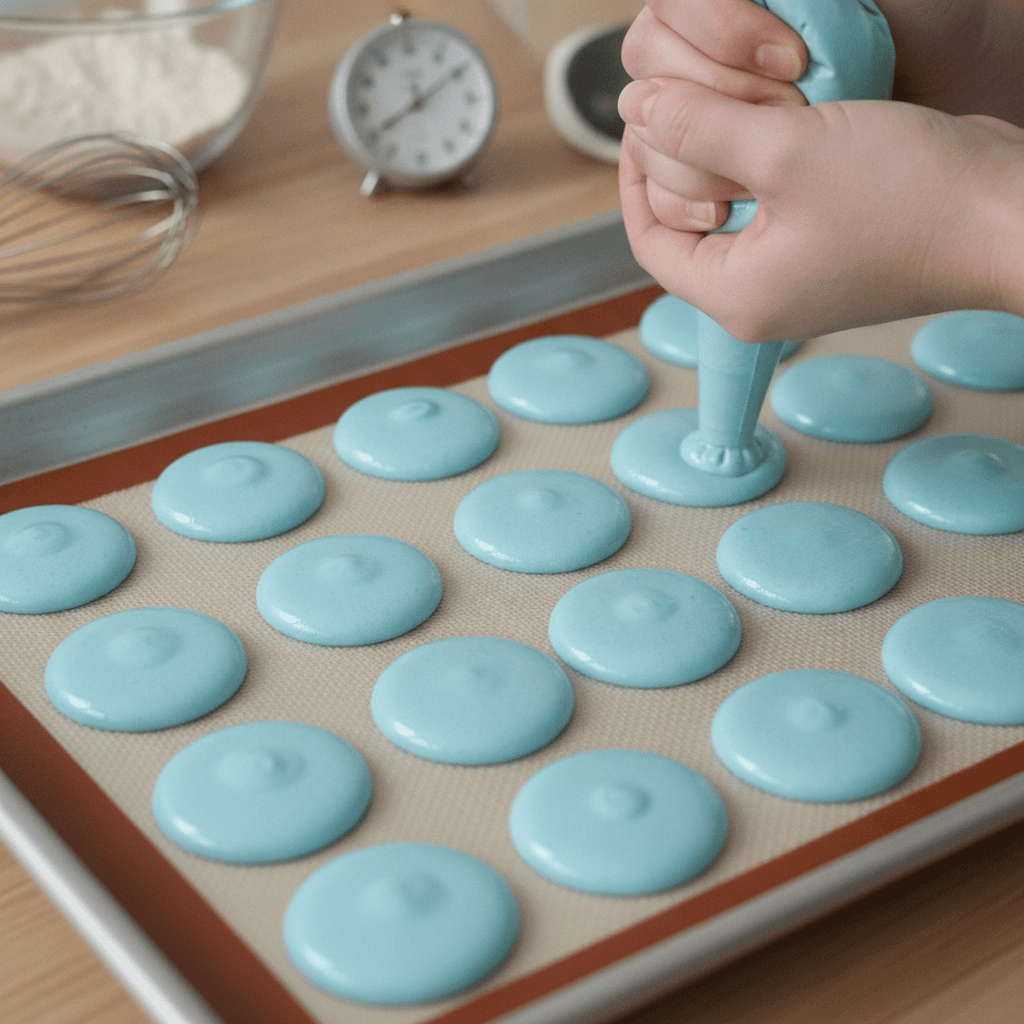
Perfectly even, perfectly round macarons — the ones with matched pairs and consistent bake — come from piping technique, not talent. Amateurs wing it and get amoeba shapes; pros follow four rules and get uniform rounds every time. This is the technique breakdown nobody gives you explicitly.
Rule 1: Vertical Bag, Steady Height
The bag must be perfectly vertical (perpendicular to the mat) with the tip half an inch above the surface, constant. Any angle produces ovals; any change in height changes the rate of spread. The mental model: you're extruding a straight column of batter downward, and gravity does the rounding. This is the rule beginners violate most without knowing — their hand drifts, the angle tilts, and the piped shells bake as the tilt said they would. Watch your own angle in a mirror the first time; most people are not as vertical as they think.
Rule 2: Stop-Before-Lift (The String Killer)
The amateur telltale is the 'tail' — the little string of batter at the shell's peak that bakes into a bump. The fix: stop squeezing, count 'one,' THEN lift straight up. The residual pressure in the bag releases into the center of the round before you break the contact, so no string forms. This single habit (squeeze-stop-pause-lift) is the difference between amateur-piped and bakery-piped shells, and it takes one tray of practice to internalize.
Rule 3: Use a Template (Training Wheels Forever)
Print or draw a template of 3.5cm circles, spaced 2 inches apart, and slide it under your parchment. Trace the circles by piping into the outline: the visual guide turns size estimation into a tracing exercise, which is infinitely more consistent. Even professional kitchens use templates — there's no prize for piped-freehand consistency at the cost of time and energy. We use them at the bakery every single day. You should too. Print the template once, laminate it, keep it with your baking mats.
Rule 4: The Counting Method (Size by Rhythm)
Consistent pressure + consistent time = consistent size. Pipe each shell with a one-one-thousand, two-one-thousand, three-one-thousand count at even pressure — the rhythm is the size-control mechanism. Slower count = bigger shells; faster count = smaller. Pick the count that hits 3.5cm on your template with your particular batter's thickness and stick to it. The same counting approach then transfers to every other piping you'll do — it's the piping-bag equivalent of the 'cook to the number' idea, except the number is seconds of squeeze.
The Wrist Flick (Advanced but Learnable)
For a perfectly flat-topped round (no peak): after the stop-and-pause, a tiny lateral flick of the wrist as you lift cuts the batter cleanly against the surface. This is a fine motor skill that develops over 5–10 batches — early on you'll smear a few, then it'll click. The flick isn't essential (the shell's peak usually settles during the rest anyway), but it's the finishing move of the professional piping hand.
Troubleshooting Roundness (When Perfectly-Piped Shells Still Bake Wrong)
If your piping is right but your shells still bake uneven:
- Tilted shells: your oven heats unevenly front-to-back; rotate the tray at the bake's midpoint
- Cracked + perfectly round: your oven is too hot — shape was fine, heat was not
- Lopsided feet: air currents in your oven — try a different rack position
- The shells flatten on one side: drafts — check for a kitchen fan, window, or AC near where you're resting
Piping gets you to round; the oven determines if they stay that way. Both halves of the process are visible in the finished mac — ours are what happens when both are right, every batch.
Vertical bag, stop-before-lift, template, count — four rules to perfectly round macs. The results look like us: professional shells, shipped.