How to Set Up an Art Corner at Home (Even With No Space)
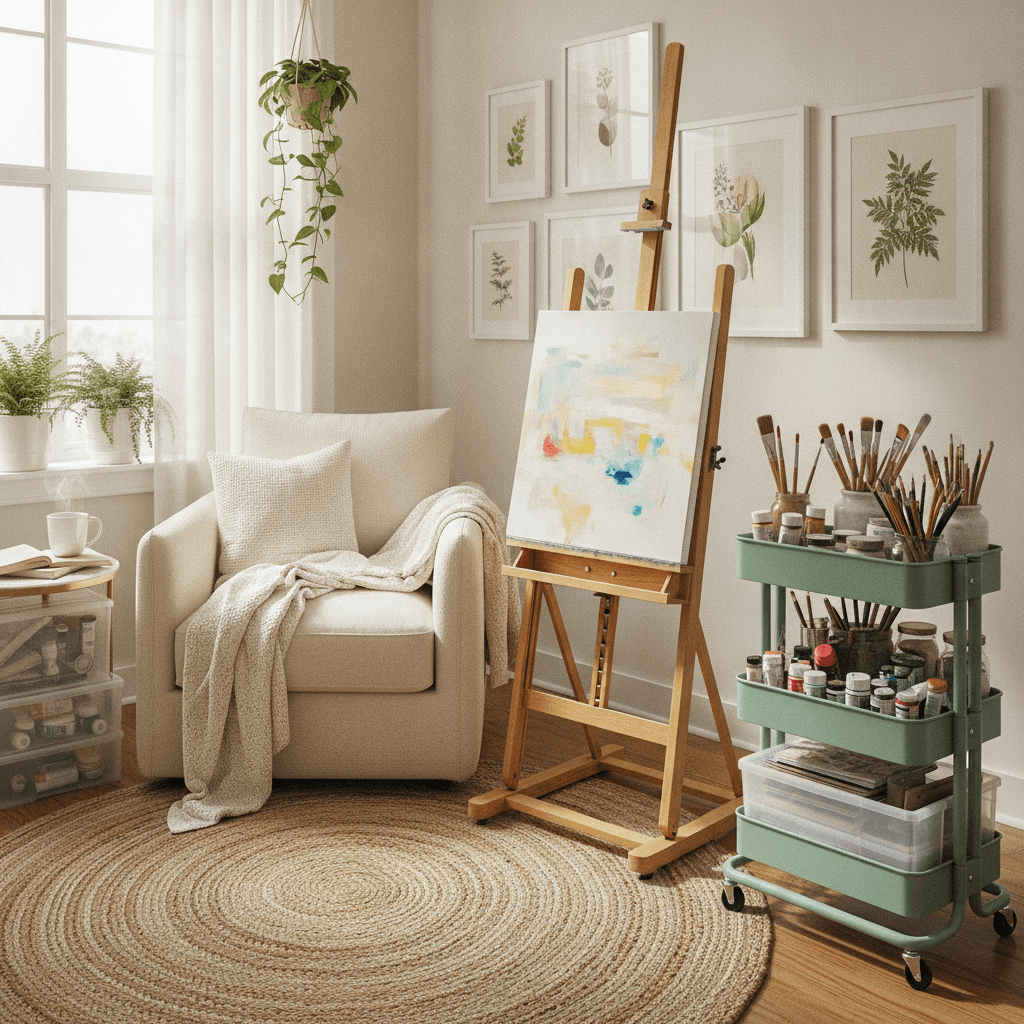
The #1 killer of home creative practice isn't motivation — it's setup friction. If your paints live in a closet bin, you will not paint. The art corner solves this with a dedicated, visible, always-ready space, and you can build one into any apartment with a rolling cart and $50. Here's the complete setup guide.
The Core Principle: Visibility Is the Practice
Behavior research on habit formation is unambiguous: visible cues beat willpower every time. An art corner's primary function isn't to store supplies; it's to exist in your peripheral vision as an invitation. This is why the rolling cart beats the closet, and why 'out on the desk with paper loaded' beats 'neatly packed away.' Your future self paints when the barrier is two minutes, and skips when it's twenty.
The Rolling Cart Method (for the Space-Poor)
The $50 setup that fits anywhere:
- A three-tier rolling cart (the classic IKEA RASKOG or similar, $20–35) — supplies live on it, the whole thing parks against a wall and rolls to wherever you'll work
- Top tier: current active supplies — the palette, current brushes, the sketchbook, water cups
- Middle tier: the medium's kit (watercolors, acrylics, or drawing tools)
- Bottom tier: paper/panels/canvas stock, rags, and the 'archive' (finished work in a portfolio folder)
Where it parks when you're not using it: a corner of the kitchen, the side of a bookshelf, a hallway alcove — it needs a two-foot footprint and access to light. Where you actually work: anywhere — the cart rolls to the kitchen table, the couch side, the desk.
The Desk Corner Method (For Those With a Surface)
If you have 2 feet of desk or table edge:
- Claim the corner permanently — 'temporary' art setups are the ones that get packed away and never unpacked
- A cheap desk lamp with a 5000K daylight bulb (crucial — warm household LED bulbs hide half the color range and you'll mix colors wrong)
- A vertical file holder for paper/panels standing up (flat paper stacks get ignored)
- A small lazy-susan caddy for the active tools (spins, holds 20 brushes/markers, sits in 8 inches)
- A drop-cloth or cutting mat under the working area (the table stays clean = the setup survives roommates/spouses)
Lighting: The Overlooked Upgrade
Color accuracy under home lighting is the silent quality killer: warm household bulbs (2700–3000K) make reds and yellows look stronger and blues weaker — you paint colors that don't look the same in daylight. The fix:
- A daylight lamp at the art station (5000–6500K, high CRI if you can find it) — $20–40 and the single best art-supply purchase after brushes
- Natural window light when possible — set the corner up perpendicular to a window, never with your back to it (shadows fall on the page)
- Check your phone's white-balance habit: if you photograph your work with warm room light, the photos look off even when the painting doesn't — the light fix is the photo fix too
Supply Minimalism (Resist the Store)
Art-supply stores are designed to make you feel under-equipped. Resist. The actual starter kit for any medium:
- Watercolor: 12-pan student set, 2 brushes (rounds 6 and 10), 140lb paper pad, 2 cups, paper towels — $30
- Acrylic: 5 tubes (white, black, ultramarine, yellow, crimson), 3 brushes, canvas pad or small canvases, palette (paper plate) — $35
- Drawing: sketchbook, pencil set (2B/4B/6B), eraser — $15
The discipline: earn supplies with use. The next supply purchase happens when the current setup limits something you specifically tried to do — not because the store smelled like possibility.
Motivation Architecture: Make Starting Stupid-Easy
Beyond visibility, three structures that keep the corner alive:
- The 'always-loaded' rule: paper in the pad, water cups clean and empty (not left with old water), brushes clean — end every session set up for the next, so next-starting is zero work
- A physical 'in-progress' tray: unfinished work goes in sight, not in a drawer — the reminder that there's something to return to is the strongest pull back
- Ten-minute permission: the rule that you're allowed to stop after ten minutes — most sessions that start 'just ten minutes' run forty; the commitment device is the micro-start
- Social anchoring: one class a month at a studio session keeps the practice attached to a calendar event and outside accountability — the home corner is daily, the studio night is monthly, and they feed each other
Two square feet of corner, a cart, a daylight bulb: that's all you need to be someone who makes things at home. Start tonight. And when you want the guided version, the studio stools are waiting.