Macaronage Explained: The Fold That Makes or Breaks Your Macarons
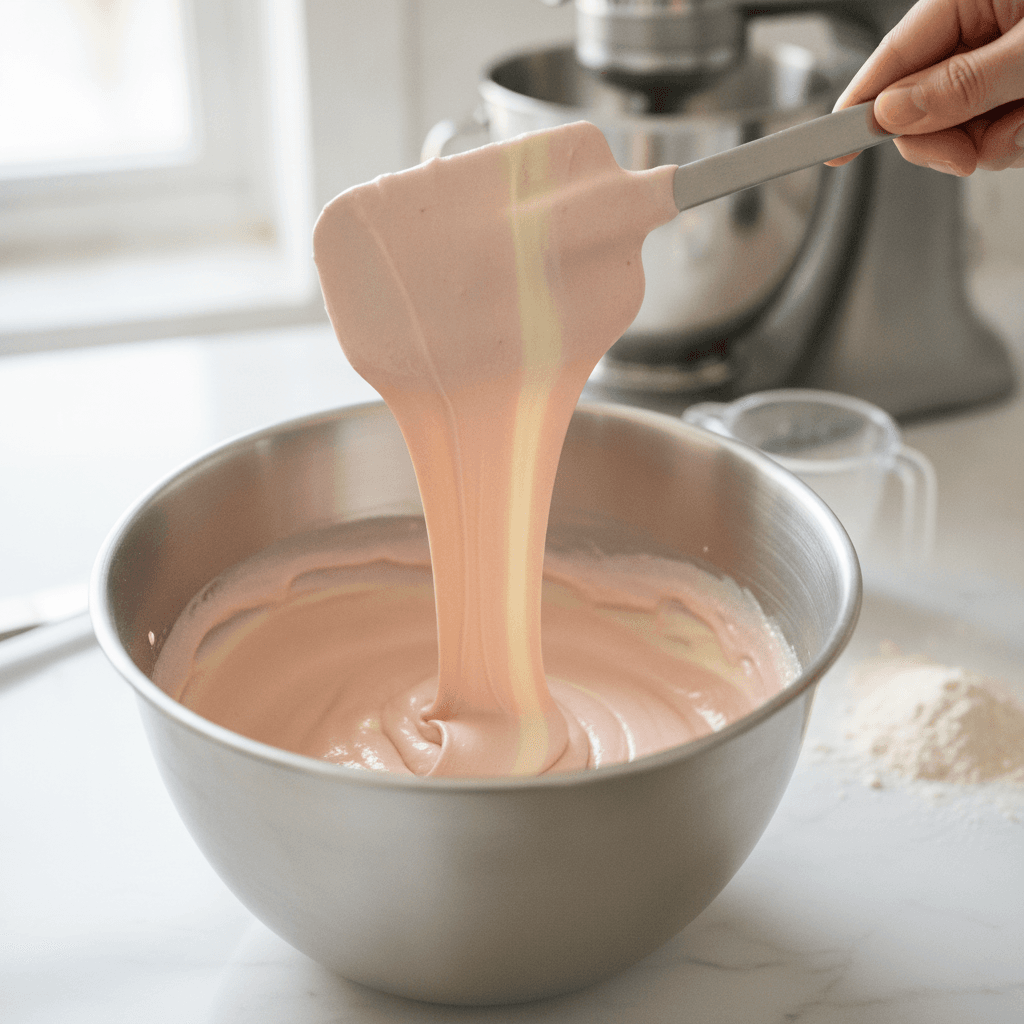
Every macaron failure — cracks, hollows, no feet, wrinkles — traces back to the meringue, the oven, or one deceptively simple step: macaronage, the folding of the meringue into the almond paste. It's thirty seconds of technique that bakers argue about endlessly, and it's the skill that separates a lucky batch from a repeatable one. Here's what it actually is and how to nail it.
What Macaronage Is Doing Scientifically
You're performing two opposite jobs at once: combining two mixtures fully *and* deflating the meringue by a controlled amount. Not preserving all the air (that's cake); not beating it all out (that's a cracker). You're aiming for a batter with enough moisture to flow and enough foam structure to rise into a dome with feet. Under-mixed batter holds too much air, bakes up lumpy, and cracks. Over-mixed batter has too little, spreads flat, and bakes hollow or wrinkled with frilly feet. The window between those is maybe ten folds wide.
The Fold, Demystified
Use a flexible spatula. Around the bowl, through the middle: scrape the spatula along the bowl's side, scoop under the batter, then cut down through the center, folding over as you go. Rotate the bowl a quarter turn. Repeat. Some bakers add a periodic "smear" — pressing the batter against the bowl side — to knock out excess air deliberately. The smear is controversial and effective; use it sparingly in the last third of mixing when you're fine-tuning.
The Ribbon Test
The classic doneness check: lift your spatula and let batter fall back into the bowl. At the perfect stage it should fall in a slow, thick, continuous ribbon that piles on the surface and melts back into the mass within about 10–20 seconds. If it falls in lumps or clumps and sits there: keep folding. If it pours like pancake batter and disappears instantly: you've passed the point (note it, bake it anyway, adjust next batch).
The Figure-8 Test (Our Preferred Check)
Ribbon tests are subjective, so here's a more binary one. Lift a scoop of batter and try to draw a figure-8 in the bowl with the falling stream. If the ribbon breaks before you finish the 8, keep folding — three folds, test again. If you can draw the 8 smoothly, stop. Stop means stop: two "just to be safe" folds past this point is exactly how batches die. We teach this test at every level of baker because it converts a feeling into a pass/fail check.
Variables That Move the Target
How many folds you'll need (usually 35–55) depends on things you can't fully control, which is why fold *counting* alone fails:
- Meringue stiffness: stiffer meringue survives more folds
- Almond flour fineness: coarser flour needs more folding to come together
- Humidity: wet days make batter looser sooner
- Coloring: gel colors add liquidity — subtract a few folds
- Batch size: doubled batches need proportionally fewer folds per gram
This is why every experienced baker says "mix to consistency, not to number" — the tests above are the consistency.
Calibrating Yourself With One Sacrificial Batch
Here's the fastest way to build macaronage feel: make one batch, pipe it in thirds at three stages — slightly under-mixed, just right, slightly over-mixed (fold five extra times between tray sections). Bake all three. You'll see the lumpy-tops, the perfect-feet, and the spread-flats side by side from the *same* oven and meringue. That single experiment teaches more than ten videos. And if you'd rather taste the target first, a box of our shells gives you the texture reference — chewy center, smooth dome, feet like a ruffle — to calibrate against.
Master the fold and the rest of macaron-making gets easy. And when the learning curve gets steep, we're always baking — New Windsor-made, shipped anywhere in the US.