Paint and Sip for Beginners: What Actually Happens at Your First Class
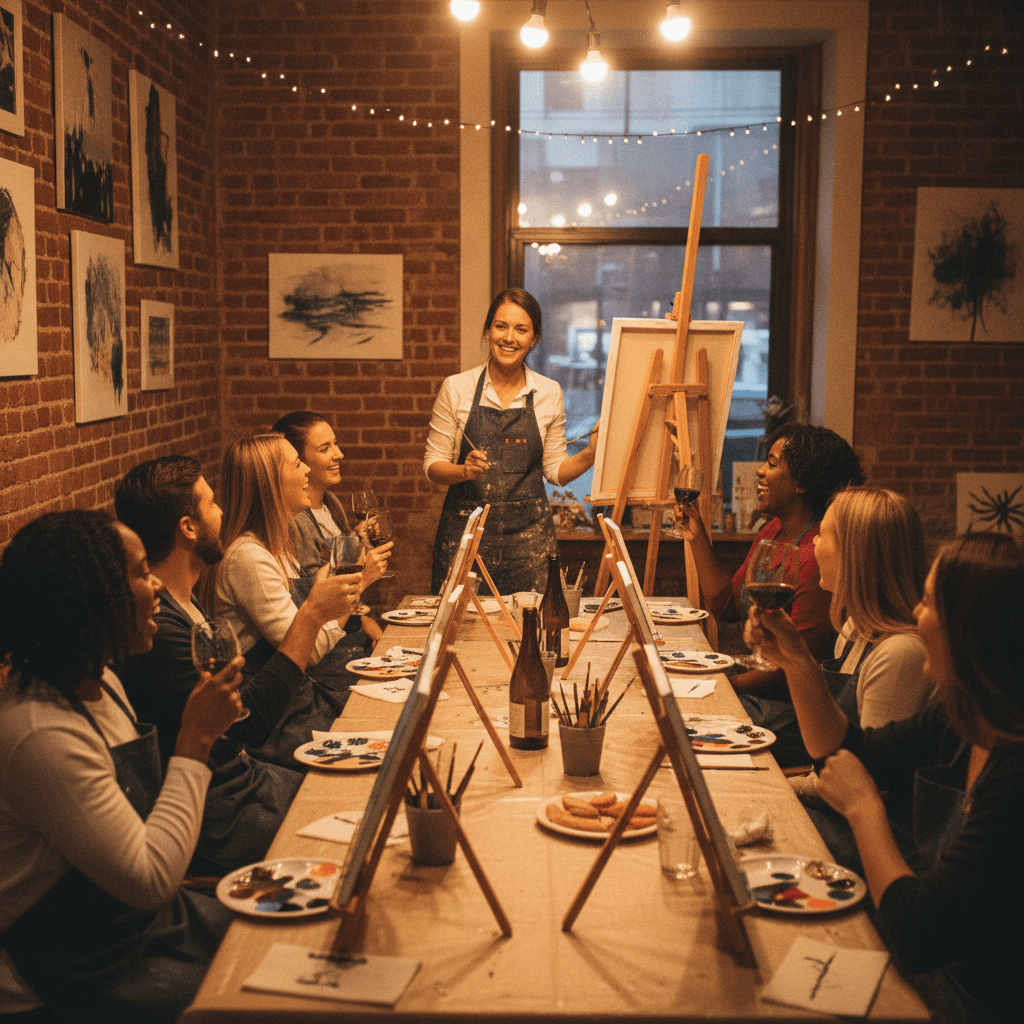
If you've never been to a paint and sip, the unknowns are the intimidating part: Do I need to know how to paint? What if mine looks terrible? Is there a test? (There is no test.) Here's the honest, step-by-step of what actually happens from the moment you walk in to the moment you carry your canvas out — so the only surprise is how much you enjoy it.
Arrival: The First 15 Minutes
Arrive 10–15 minutes early. You'll check in, find your seat (everything is pre-set: easel, canvas, brushes, palette with paint blobs already squirted, water cup, apron), and grab your drink. This pre-start window matters — it's when you settle in, meet your table neighbors, and get the nervous jokes out of the way. Every session we've hosted at our New Windsor paint nights starts with at least three people announcing "I can't even draw a stick figure." Every session ends with those same people taking canvas selfies. It's almost a law of nature.
The Teaching Method: Follow-the-Leader, Loosely
The instructor stands at the front with their own canvas and paints the featured painting step by step — background first, then big shapes, then details. You follow along each step. The key thing beginners miss: the instructor demos, then you do. You're never expected to watch for ten minutes and reproduce from memory. Brush strokes are shown at actual speed, and steps repeat for stragglers. Nobody gets left behind because the whole room moves together.
The Permission Slip You're Actually Buying
Here's what nobody tells you before your first paint night: the painting is the excuse, not the point. The value is two hours where your phone stays face-down, your hands are busy, and your brain gets to be mediocre at something without consequences. Instructors at good studios actively encourage deviation — change the colors, add a cat, turn the sunset into a sunrise. Your painting being 'correct' is not on the rubric. There's no rubric.
What the Drinks Actually Do
The sip half isn't about getting tipsy (most sessions are one or two glasses over two hours). A small amount of wine does one useful thing for beginners: it lowers the inner critic's volume just enough to make a bold brushstroke instead of a timid one. The most common sentence we hear around the one-hour mark is "okay, I stopped caring and now it's actually good." That's the entire pedagogy of paint and sip, honestly.
Mistake Recovery: Acrylic's Secret Feature
Acrylic paint dries fast — which beginners fear — but fast drying means fast correction. Any mistake can be painted over in about four minutes. Instructors carry blow-dryers for exactly this. The universal fix script: let it dry, paint over it, done. The worst-case scenario of a paint night is a canvas with one extra layer of paint on it, and layered acrylic often looks *better* — more depth, more texture.
Leaving: What You'll Take Home
You'll leave with a 16x20 canvas, dry enough to carry by its frame (protect your car seat just in case), plus whatever photo evidence you collected. Practical notes: canvases at home need a few days to fully cure before you wipe them, and they don't need sealing or framing — an unframed canvas on a wall hook is the standard display. Fair warning about the other souvenir: roughly half of first-timers book their second session within a month. It's as habit-forming as advertised.
Ready for your first night? Check the schedule for our New Windsor paint and sip sessions — beginner-friendly means beginner-friendly, and we mean it.