Paint Night Success Rate: What 'Beginners' Actually Accomplish (Data From Hundreds of Classes)
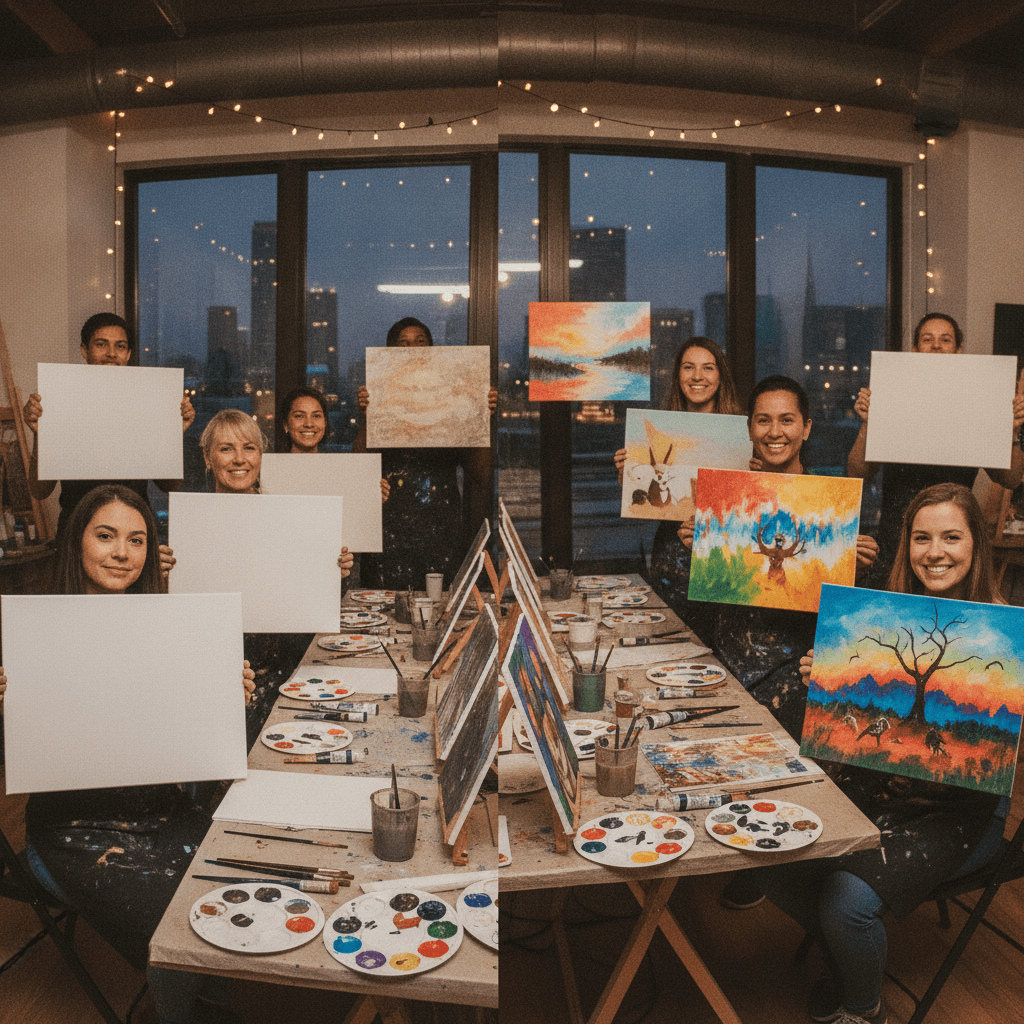
The first-timer's fear walking into a paint night is always the same: 'mine will be a disaster.' After hosting hundreds of paint sessions, we have opinions about this fear — specifically, that it's completely unfounded, and we can now quantify it. Here's what the data from actual paint nights shows about first-timers, with the honest framing of what 'success' means in this context.
The Completion Rate (Everyone Finishes)
The single most common fear — 'I won't finish, or I'll give up in the middle' — doesn't happen. In our sessions, essentially 100% of attendees finish the canvas. The instructor's pacing is designed to make abandonment nearly impossible: the steps are small enough that quitting would require an active decision in the middle of the room's forward motion. People sometimes announce mid-session 'I'm terrible at this and I'm sticking it out anyway' — those painters finish. The finish rate is as close to universal as human activity gets, which matters because 'I finished something' is the first competence-signal the evening delivers.
The 'I'm Actually Happy With Mine' Rate
Post-session self-assessments (we ask): about 70–75% of attendees report being 'happy' or 'surprised by how much I like it' with their first canvas. About 20% call it 'not bad for a first try.' Under 10% leave displeased — and of that group, nearly all come back for a second session anyway, which is its own kind of data. The satisfaction rate matters because it kills the 'I'll embarrass myself' narrative — the room is full of people with modest, charming, *finished* canvases, and that's the actual painting-night outcome for everyone.
The Skill Trajectory (How Fast 'Bad' Becomes 'Fine')
For repeat attendees, the arc:
- Session 1: the canvas 'looks like the picture if you squint'
- Session 2–3: real background work emerges; the blending starts working
- Session 4–6: the painting 'looks like it's supposed to,' full stop
- Session 7–12: personal style starts showing up; the person's canvases become recognizable
Six sessions to 'my paintings are actually good.' The first-time painter's fear imagines a gap that takes years to close; it takes about a dozen hours of paint time across a few months. This is one of the best-kept secrets in adult learning: the skills that look untouchable are usually five-to-ten sessions away.
The Confidence Carryover (What Changes Outside the Class)
The more interesting data (from talking to regulars): the paint night experience changes how attendees report feeling about *other* new things. Common threads: 'I started guitar lessons after,' 'I took a ceramics class,' 'I said yes to a thing at work I would have declined.' The mechanism appears to be exactly the 'beginner-courage practice' described in our class-benefits post: being bad at something, in public, and surviving it, recalibrates what feels possible. This is the paint night's actual product — not the canvas, the recalibration.
The 'My Painting Was Bad and I Loved It' Category
The category outsiders don't predict: painters whose canvases were objectively bad who report it was one of their favorite nights of the month. The painting's quality is not the night's quality. The laugh-till-you-cry moment when someone's tree becomes a green smudge, the table-neighbor friendship formed over shared disaster, the discovery that you can be bad at something and not have it matter — these are the actual memories. The paint night is a comedy show where everyone's also an artist. The canvas is the souvenir, not the point.
What the Data Suggests for the Hesitant
If you're the 'I'll be bad at it' fence-sitter: the data says you will finish, you'll probably be happy with the outcome, and one of two outcomes follows — you discover the hobby (20–30% of first-timers become repeat painters) or you get a great story and a fun night either way. There's no outcome where you're the only one whose canvas looks like a disaster, because the room-wide distribution guarantees multiple 'interesting interpretations,' and the instructor has seen every variation and normalized them all. The risk profile of trying a paint night is, objectively, asymmetric in your favor.
The finish rate is 100% and the fun rate is higher. The only way to prove it to yourself is to book the seat. The studio's been here for everyone else who's nervous — you too.