Sketchbook Habit for Overthinkers: How 10 Ugly Minutes a Day Unlocks Creativity
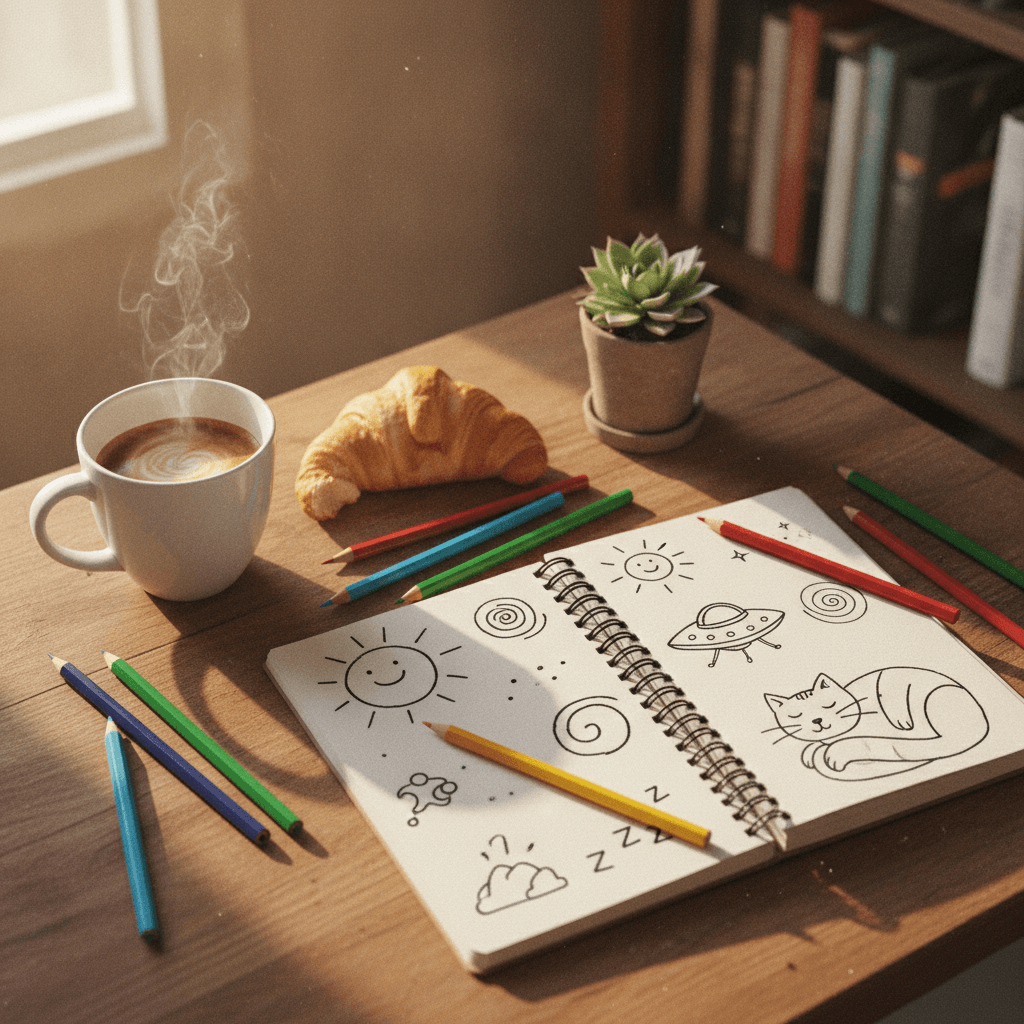
The sketchbook habit is the most prescribed creativity practice and the least reliably adopted — because most advice assumes you can draw. This guide doesn't. It's for the overthinkers, the 'I can't draw a stick figure' crowd, the adults whose last drawing was on a middle-school desk. Ten ugly minutes a day, starting with the only equipment rule that matters: an ugly, cheap, slightly-too-small notebook.
Why the Cheap Notebook Is Non-Negotiable
A beautiful $30 sketchbook has a psychic cost: every page feels like it must deserve the paper. That's the trap — preciousness kills practice. Buy the ugly $6 sketchbook, the one whose mediocre paper almost dares you to waste pages. The entire practice runs on permission to make garbage, and the cheap notebook is that permission made physical. Put your name and 'BAD DRAWINGS WELCOME' on the inside cover and the practice has begun before you've drawn anything.
The 10-Minute Structure (So You Can't Overthink It)
Set a timer. This matters — the timer is the kill-switch for the inner critic:
- Minutes 0–2: warm-up marks. Scribble, fill a corner with lines, circles, hatching. Hand loosening, brain warming.
- Minutes 2–5: draw what's in front of you. Mug, keys, hand, plant, the cat. Badly. Proportion doesn't matter; looking matters.
- Minutes 5–9: draw from memory or imagination. Yesterday's breakfast, a house you'd like to live in, the cat again but fancier.
- Minute 9–10: one sentence in the corner. Date plus one honest line: 'mug went badly, cat is smug.' That's the logbook — it makes tomorrow's session feel like a continuation, not a fresh start.
Timer goes off, pen goes down. Done.
What This Is Actually Training
The visible output (drawings, improving slowly) is the least valuable product. What the habit builds: (1) observation — drawing a mug teaches you what a mug actually looks like, and that quality of attention bleeds into everything; (2) frustration tolerance — making bad marks and continuing anyway is a transferable skill for every other creative practice you own; (3) identity — after three weeks you become 'someone with a daily practice,' which is a self-story that unlocks other practices quietly. This last one is the hidden prize.
The Blank-Page Fear, Addressed Mechanically
If page one scares you: skip it. Start on page 7, or on the back cover, or scribble across page 1 tonight so it's 'ruined' and the book can begin tomorrow. If the whiteness daunts mid-practice: pre-tone pages (tea-stain them, or washi-tape the corners, or paint a color wash on the next ten pages in one sitting) so every session starts mid-conversation rather than from silence. Blank-page fear is universal among artists; overcoming it is a learned skill, and these cheats are how it's learned.
Days You Miss: The Only Rule
You will miss days. The only rule that protects the habit is: never miss two in a row. One missed day is life happening; two is a new habit forming, and it's not the one you want. When you come back, don't apologize to the notebook, don't catch up, don't redouble — just a normal ten minutes, the date, and your sentence. The sketchbook doesn't keep score; only guilt does that, and guilt is the enemy of the practice.
Where It Leads (Realistic Edition)
In three months you'll have 60-90 pages of progressively less-bad drawings and one or two genuinely charming surprises. You'll probably find a subject that clicks (most people do — buildings, faces, plants, food) and that's your on-ramp to the next stage: a class, a medium you want to try properly, maybe a paint night to see how your marks look at canvas-scale in color. Sketchbooks are the farm team for every visual art hobby; everything you try later will draw on (sorry) what the notebook taught you about seeing.
Ten ugly minutes. Start tonight. And when the sketchbook makes you curious about real paint, we'll see you at the studio.