Team Building Events for Introverts: Activities That Actually Include Everyone
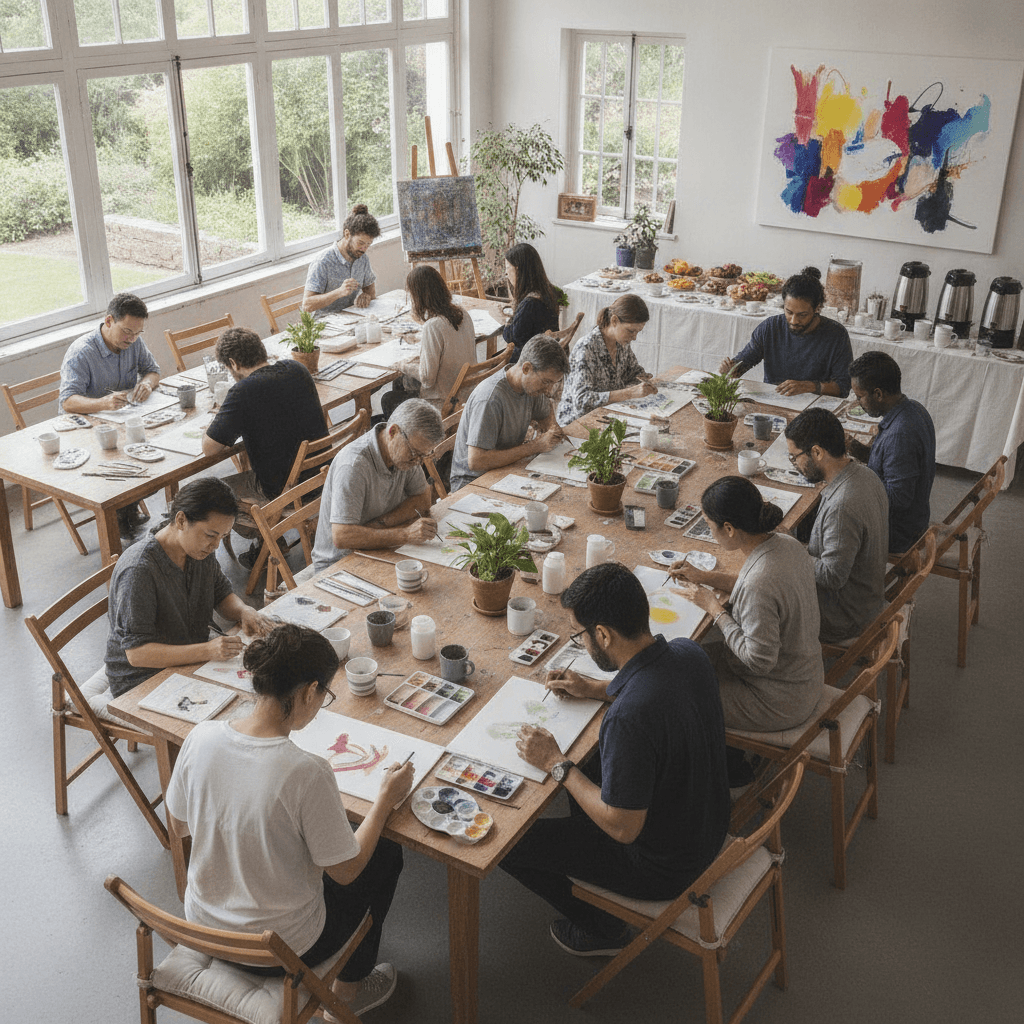
Half your team is introverts. Most team building ignores this completely, designing for the extroverts who will vocalize enjoyment and fill out the survey. The result: a third to half of your attendees enduring events that drain them, and their post-event feedback is polite while hiding the truth. Activities designed with introverts in mind work better for everyone — here's the framework.
What Actually Makes an Event Introvert-Hostile
Introversion (quick definition) is energy economics: social interaction costs energy rather than generating it. The introvert-hostile team event features:
- Mandatory performance: individual spotlights, presentations, 'go around and share,' icebreaker games ('tell us your fun fact!' is a small trauma for quiet people)
- Unstructured social time: 'just mingle!' is a punishment, not a pleasure, for introverts (the work of finding conversation without structure is the exhausting kind)
- Sustained eye contact and engagement: cocktail-party formats
- High energy demand over long duration: all-day team events without quiet pockets
- Forced enthusiasm: 'cheer for the team!' energy requirements
Notice these are all standard team-event features. The format defaults are the problem.
The Introvert-Friendly Activity Profile
Activities that genuinely include introverts share specific features:
- Parallel activity with ambient socialization — everyone's doing the same thing side by side; conversation is optional and arises naturally from shared reference points (this is exactly why paint events rate so highly for introvert-inclusion)
- A shared focus object — the canvas, the project, the puzzle: something to look at that isn't each other
- Structured interaction available but not mandatory — the option to collaborate without the obligation to perform
- Natural breaks — refills, material changes, the pause points where socializing is organic
- An endpoint that releases cleanly — no forced 'let's all keep hanging out' pressure after the event's scheduled end
Ranked: Team Activities by Introvert-Friendliness
- Excellent: paint nights, pottery/ceramics classes, cooking classes (structured parts), escape rooms (for analytically-inclined introverts specifically — the problem-solving focus distracts from social demands), volunteering events with role structure
- Good: brewery/distillery tours (the tour provides structure), food tours, guided nature walks (walking side by side is the introvert's preferred social format)
- Risky: karaoke, improv workshops, 'speed networking,' any competitive sport, anything with 'perform' as a verb in the description
- Actually not team building: happy hour as the sole event, 'team lunch' with no activity, anything billed as 'mandatory fun'
How to Design the Even-More-Inclusive Version
Within an activity, small choices matter:
- Arrival: name tags with one piece of low-stakes info (a hobby, a favorite food) — conversation infrastructure
- Seating: mixed tables or assigned spots (removes the 'where do I sit' social navigation anxiety)
- The host/instructor does icebreaking via the activity, not personal disclosures: 'show me your background color choices' vs 'tell us about yourself'
- Breakout roles for quiet people: the person who prefers not to talk gets to be the timekeeper, the photographer, the one who checks supplies — roles are participation without performance
- Closing without a share-out: the event ends with the artifact or the meal, not with 'everyone share one thing you learned'
- Optional post-event: the 'and of course whoever wants to grab drinks after' framing makes the extension opt-in rather than implied
How to Tell If Your Team Events Are Failing the Quiet Half
Signals: post-event survey response rates skew low; some attendees consistently decline; the same vocal subset always narrates the event; the quieter people attend but leave promptly at the end; and in followup, introverts describe events as 'fine' while extroverts say 'amazing.' The deeper test: an introvert teammate will tell you honestly in a 1:1 if events feel like a tax. If that answer surprises you — that's the answer's data.
The Win-Win Conclusion
Introvert-inclusive events are also better for everyone else: the focus on shared work over forced social performance is relaxing for *all* temperaments. The extroverts still get their socialization (in a more genuine form); the introverts get to actually be there. The paint-night model is the proof — it consistently gets the strongest cross-temperament feedback of any team activity we run, and the mechanism (parallel creative work with ambient social) is the specific fix for the inclusion problem. Test it once with the skeptics on your team; the format usually converts them.
Design for the quietest person in the room and everyone gets a better event. Try the studio's take on inclusive team building: book a paint event — everyone paints; nobody has to perform.