Team Building Paint Events vs. Escape Rooms: An Honest Comparison
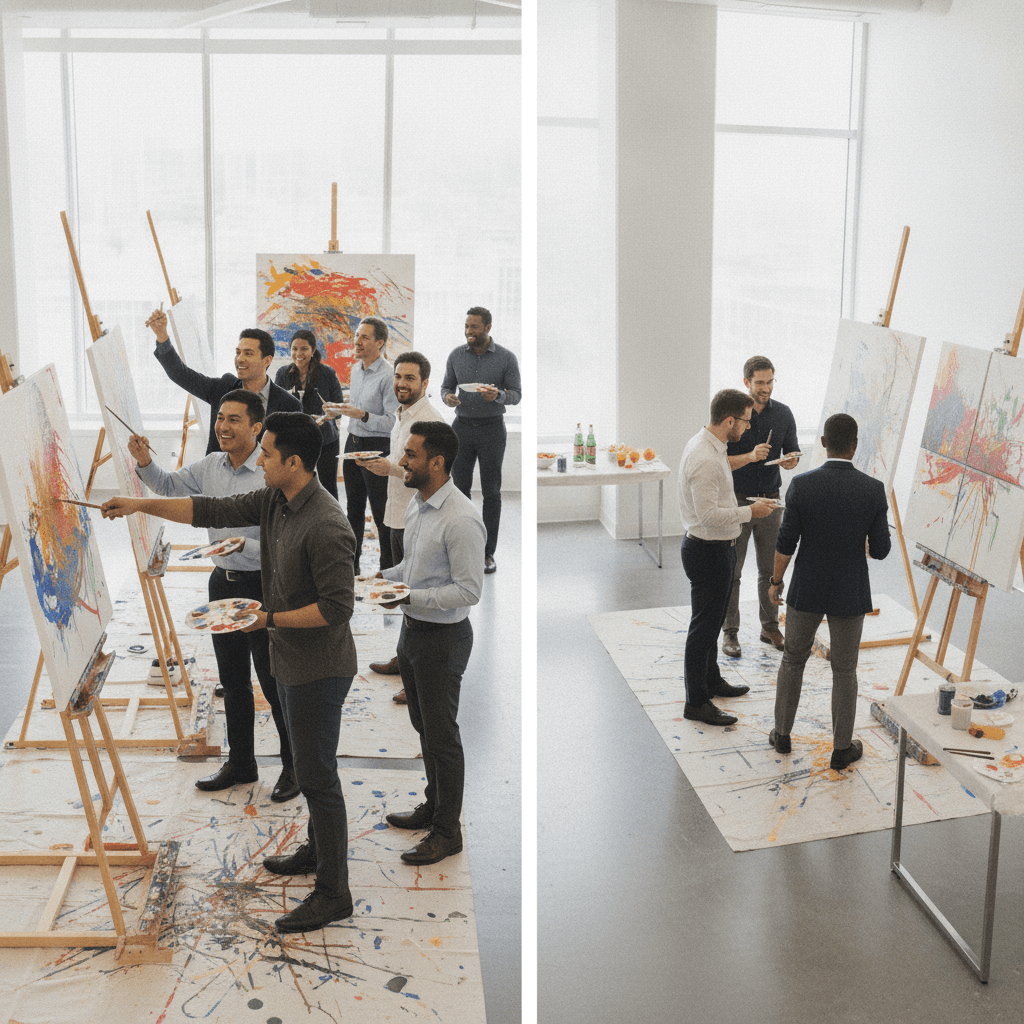
When a team lead schedules team building, the shortlist usually comes down to: escape rooms, axe throwing, cooking classes, or a paint event. All four work; they work differently. Here's the honest comparison — from someone who hosts paint events and has heard the post-event debriefs about all the alternatives — so you can pick based on your actual team rather than a marketing pitch.
The One-Paragraph Verdict
Escape rooms are best for small competitive teams (4–8) who want a shared puzzle-high and have strong existing chemistry. Paint events are best for groups of any size (8–30+) with mixed social energy, where including quieter teammates matters. Cooking classes are best for food-culture teams with a higher budget. Axe throwing is best for teams who'd otherwise do karaoke — it's an energy event, not a connection event. None is 'better'; they're different tools for different team problems.
Group Size and Logistics
Escape rooms: hard cap at 4–10 per room; a 20-person team splits into competing rooms, which subdivides the group you're trying to bond. Booking multiple rooms simultaneously is possible but fragments the shared experience ('we escaped, you didn't' is a mixed outcome for cohesion).
Paint events: scale beautifully from 6 to 40+, everyone doing the same activity at the same time. Better for big-team inclusion.
Cooking classes: similar scale to paint events (10–30), but station-based work means semi-parallel activity rather than truly shared.
Axe throwing: scales okay (lanes hold 4–6), but participation is in turns — at any moment, 80% of the group is spectating.
Introvert-Friendliness (The Underrated Metric)
About a third to half of most teams are energy-conserving introverts who experience most team-building as a performance tax. Honest assessment:
- Paint events: introvert-friendly — focus is on your own canvas, conversation is optional and ambient, no one is put on a social spot
- Escape rooms: introvert-stressful — constant required communication under time pressure, no place to hide in a 4-person room
- Cooking: moderate — collaborative stations mean some forced coordination
- Axe throwing: introvert-nightmare — the format is spectating, which means being watched
Teams with meaningful introvert populations (most engineering and creative teams) see the best post-event feedback from paint events specifically because the quiet people actually show up emotionally.
Skill-Level Equity
Does prior experience create advantage?
- Escape rooms: yes — experience dramatically helps; veteran players dominate, which creates status hierarchy mid-event
- Paint events: almost perfectly level — everyone's a beginner or can be made one; no status transfer from prior skill
- Cooking: some status transfer (the home cook vs the microwave-lifer dynamic is real and can sting)
- Axe throwing: low transfer (physically everyone starts similar)
For a team event, the equity question matters: you want an activity where the new grad and the VP are equally bad. Paint events deliver this nearly perfectly.
Cost, and What You Get for It in 2026
Realistic per-person costs:
- Escape rooms: $30–40/person for 60 minutes of activity, no food, no artifact to take home
- Paint events: $45–65/person for 2 hours with the canvas artifact, often including drinks
- Cooking: $85–125/person including the meal (the most 'complete' event dollar but also the priciest)
- Axe throwing: $25–35/person for about 45 minutes of actual throwing per person, rest is watching
Paint events rank mid-pack on cost and high on duration-of-experience. Escape rooms are shortest; axe throwing cheapest but with the least actual participant-minutes.
When Each Format Wins (The Decision Guide)
- Escape room: small team (under 10) that already likes each other, wants a challenge, competitive culture
- Paint event: any size, mixed introvert/extrovert, want a shared-and-take-home experience, inclusive of less-competitive members — (and, if you're local, our New Windsor studio runs these weekly, integrated with bakery dessert options)
- Cooking class: team strongly food-culture-oriented, larger budget, want the event to be the meal too
- Axe throwing: young high-energy team where the fun is the spectacle, already-good communicators
Default if you're unsure: paint event. The inclusion, scalability, and artifact-creation (canvases in the office afterward are a permanent team culture artifact — see the team-building guide for the post-event value) make it the format with the highest floor.
Whatever you book, the right question is 'what does my team actually need?', not 'what sounds most fun on the invite.' For paint nights in the Hudson Valley: we're here.