The Art Teacher Interview: What Creative Classes Actually Do for Adults
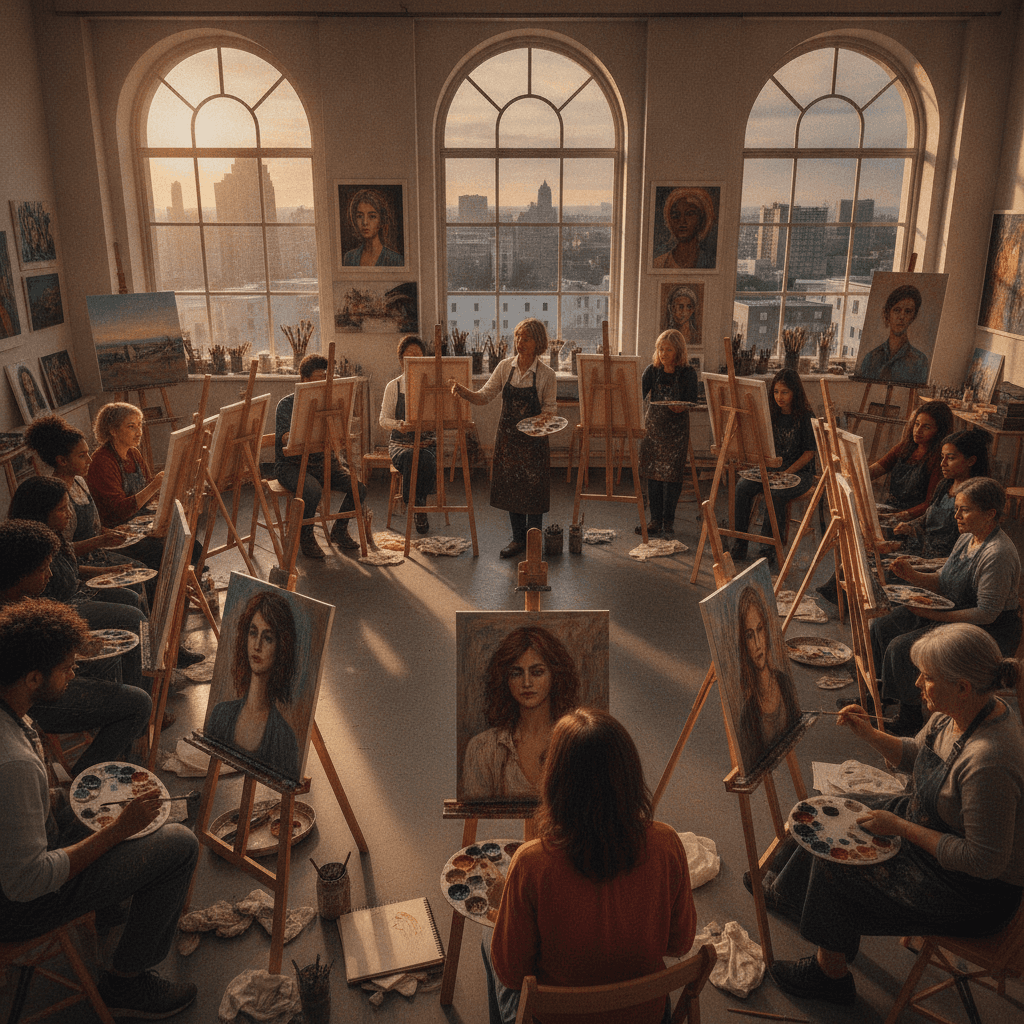
Behind every paint night at the studio is an instructor — an actual working artist who has taught hundreds of adults who arrived saying 'I can't even draw a stick figure.' This post is the collected wisdom of our instructors: what they observe adults actually gaining from creative classes, the patterns nobody expects, and their honest answers to the questions people are embarrassed to ask.
The Observation: Adults Relearn How to Try
The instructors' unanimous first answer when asked what adult classes actually do: 'they teach adults to try things again.' The mechanism is visible from the front of the room: the first 15 minutes, adults approach a canvas with the caution of people defusing something; by minute 40, the experimentation is flowing ('what happens if I drag dry white through this?'). Kids ask that question constantly; adults had been trained out of it. The class reinstates the experimental mode — and the instructors report it's the reinstating, not the painting, that people thank them for.
The Skill Nobody Names: Looking
Painting instruction is mostly taught as motor technique (brush control, color mixing) but the instructors insist the real skill transfer is *perceptual*: adults who've painted for a few sessions report noticing light differently — on buildings, on faces, on the river at golden hour. The brain's visual-processing literally re-prioritizes (you can't paint a shadow until you've SEEN a shadow, so the training forces the seeing). Former students describe it as the world 'getting higher-resolution.' An art class is, at bottom, a class in paying attention — the single scarcest adult skill of the 2020s, taught as a side effect of mixing cobalt with ultramarine.
The Social Architecture (What the Room Does)
From the instructor's vantage:
- The table-friendship phenomenon: 2 hours side-by-side at an easel produces more honest conversation than 5 dinner parties — the parallel-activity, no-eye-contact-required format (the introvert-compatible structure) loosens the guarded layer
- The skill-leveling effect: in a beginner room, the CEO and the intern are identically bad — instructors love this and lean into it ('the canvas doesn't care what you do for work')
- The returning-groups pattern: friend-groups that start as 'one-time' bookings become monthly rituals about 30% of the time; the class becomes the excuse for the friendship maintenance the adults wanted but would never have scheduled as 'let's hang out'
The Questions Adults Are Embarrassed to Ask (Answered)
Direct from the instructors' FAQ files:
- 'Is it okay to be the worst one in the room?' Yes, and you won't be — and if you are, nobody notices because everyone's looking at their own canvas. Instructors' unanimous observation: every beginner believes they're the worst one; the room's actual worst changes every session.
- 'Should I practice before coming?' No — come unpracticed. The class fixes raw technique faster than solo practice fixes it, and 'practicing wrong' for weeks installs habits that take longer to un-train.
- 'Do I keep my painting secret after?' Most people post it. The ones who don't sometimes frame it anyway. The canvas-shame phase passes within a week — by then you've made the memory and the canvas is just the evidence of a good night.
- 'Am I too old to start?' The instructors' current-oldest-student list includes regular painters in their 80s. This question has no factual basis at any age.
The Progression Path (If You Get Hooked)
For the ~30% who get hooked after the first class, the natural ladder:
- Repeat public sessions monthly — skill compounds (the trajectory data shows the arc)
- A series class (multi-week skill courses, where offered) — the instruction deepens beyond the paint-night template
- A home practice — $50 of supplies, 30 min weekly (see the watercolor starter guide for the at-home parallel)
- The local art community — the valley's art orgs, the plein-air group in season, the open-studio circuits
- Maybe the show: the local library-and-café show circuit is open to anyone; at least a dozen former paint-night students have shown work within 2 years of their first class. The instructors keep a quiet running list. It's longer than you'd guess.
What Instructors Wish More People Knew
Closing quotes, compiled: 'The painting is the excuse, not the point.' 'Every adult who says they can't paint is measuring against a memory of the one kid in fourth grade who could draw — and that kid practiced.' 'The class works on everyone. The only variable is whether you come back.' And the favorite: 'Nobody is judging your painting. Everyone is too busy being nervous about theirs. You're all just nervous together, and that's actually the activity.'
Classes teach trying, looking, and nervous-togetherness. The canvas is a bonus. Book the seat — the instructors will take it from there.