The French Macaron's Actual History (And Why 'Macaron' ≠ 'Macaroon')
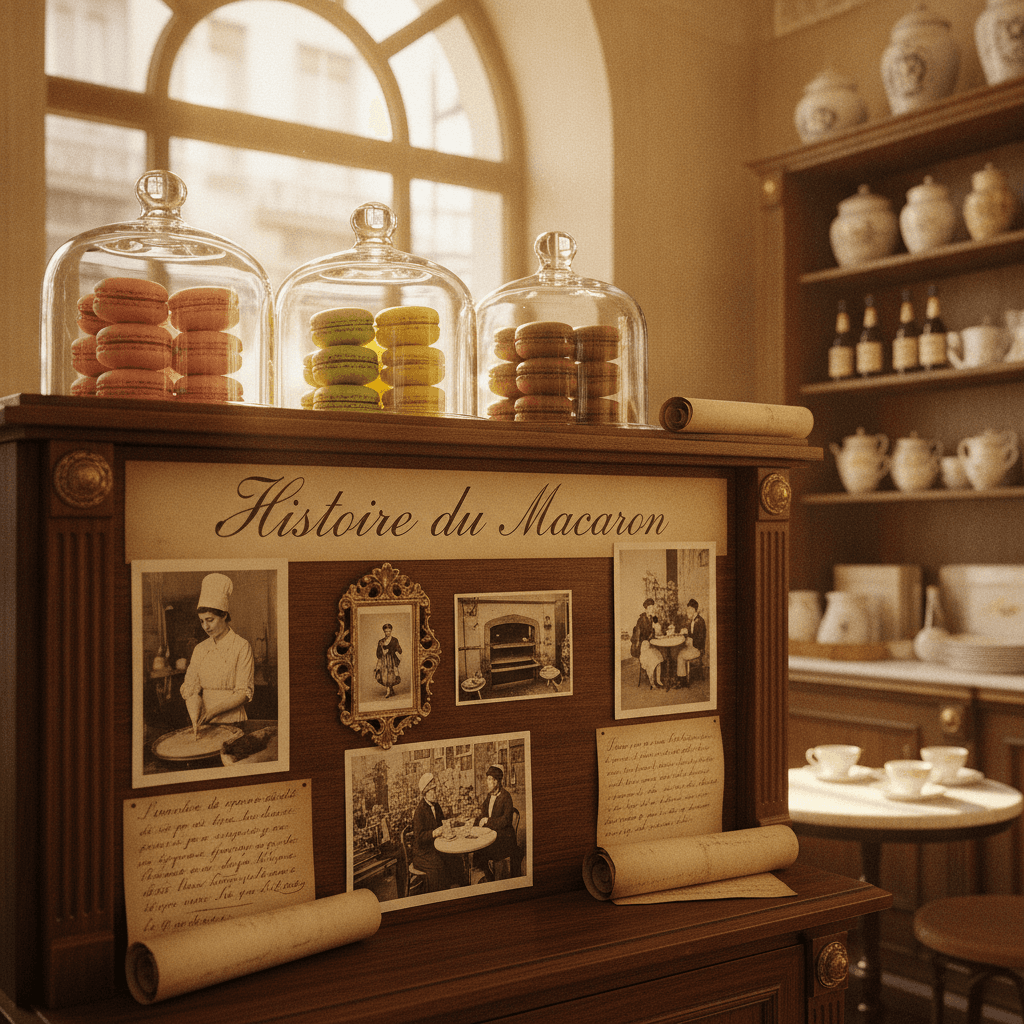
The macaron is the internet's most confused-about pastry: mispronounced, conflated with the coconut macaroon, and credited to France despite being Italian by birth. Since we make several thousand a week, we've researched the real history — and it's better than the legend, with a Medici queen, a monastery, the French Revolution, and a Parisian tea salon that changed pastry forever.
The Italian Birth (1533, Probably)
The macaron's ancestor arrived in France with Catherine de' Medici when she married the future Henry II of France in 1533, bringing Italian pastry chefs with her. The original was a simple almond-meringue cookie — almond flour, sugar, egg white, single-shelled, no filling — an Italian amaretti-adjacent biscuit. The word itself is Italian: *maccherone* / *macarone*, from the same root as macaroni, meaning 'fine dough' or 'paste.' France didn't invent it; France adopted, refined, and eventually crowned it.
The Monastery Years and the Revolution's 'Macaron Sisters'
Through the 16th–18th centuries, the almond cookie lived quietly in French monastery kitchens (nuns baked them to monastery recipes, some of which survive in French regional versions — the macarons de Nancy, de Boulay, de Cormery — single-shell regional biscuits that predate the Parisian sandwich version by centuries). The famous episode: during the French Revolution, two Carmelite nuns in Nancy — Sisters Marguerite and Marie-Élisabeth — baked and sold macarons to survive the closure of their convent, becoming 'Les Sœurs Macarons.' The street where they lived is now Rue des Sœurs Macarons. The cookie's survival through the Revolution is a nuns-with-ovens story, which is the best kind of food history.
The Parisian Transformation (1860s–1930s)
The single-shell cookie became the modern double-shell sandwich in Paris, with credit going to Pierre Desfontaines of Ladurée (the second cousin of founder Louis-Ernest Ladurée), who around the early 20th century began joining two shells with ganache. (Pierre Hermé historians debate the exact year; 1930s is the common citation.) The ganache-sandwich structure was the transformation — it turned a biscuit into a *bonbon*, changed the texture equation into the crisp-chewy-creamy format that defines the macaron, and gave pastry chefs a canvas for flavor innovation that the single cookie never offered. Ladurée's tea-salon context made it fashionable; the ganache made it great.
Macaron vs. Macaroon (Settling It Permanently)
The confusion: both words descend from *maccherone*. They diverged:
- Macaron (French lineage): almond flour, meringue-based, the sandwich cookie this blog is about — delicate, crisp-chewy, comes in every color
- Macaroon (Anglo-American lineage, diverged 18th–19th century when coconut arrived in European baking ports as an almond substitute): shredded coconut, egg white, sugar — chewy, dense, haystack-shaped, often chocolate-dipped, a Passover classic
They share an etymology and nothing else. The pronunciation difference (mak-ah-RON vs mak-ah-ROON) is real but subtle, which is why the confusion survives. When customers call our shop asking for coconut macaroons we point them warmly toward a good local source — they are a different (delicious) pastry with a different lineage, and the two deserve their separate lanes.
The Modern Era (2000s–present): The Instagram Cookie
The macaron's global explosion is recent. Ladurée's 1990s–2000s luxury expansion, Pierre Hermé's flavor innovation (the Ispahan — rose, lychee, raspberry — arguably created the modern flavor-driven macaron movement in 2001), the 2010s food-blog era, and Instagram's visual culture conspired: a small, colorful, photographable, fancy pastry was the algorithm's perfect food. The macaron became the decade's signature pastry, then the home-baker Everest (the Great British Bake Off effect), then the mail-order luxury (ours, shipping nationwide, among many — the category we serve). It is now less a cookie than a format: the almond-meringue sandwich vehicle for any flavor a baker can dream. Four centuries, one structure, still evolving.
Why the History Matters for the Home Baker
Besides being good trivia: the history explains the technique's fussiness — the macaron is a Renaissance almond cookie refined by nuns and Parisian pastry scientists into something with narrow tolerances; the finickiness isn't a flaw, it's the lineage. The monks-and-Nancy-nuns versions were rustic and forgiving; the Parisian sandwich version is engineered. When you fight a batch of hollows (the archives) you're wrestling four centuries of pastry ambition, and that's a reasonable thing to find hard. The bakery's role in this lineage — making the Parisian version consistently for everyone who doesn't want to fight the meringue — is, we'd argue, what the Ladurée lineage always intended: macarons for everyone.
From Catherine de' Medici's chefs to our kitchen in New Windsor — 500 years, still almond, still worth the fuss. Taste the current chapter: the shop or shipped to your door.