Watercolor vs. Acrylic for Beginners: Which Paint Should You Start With?
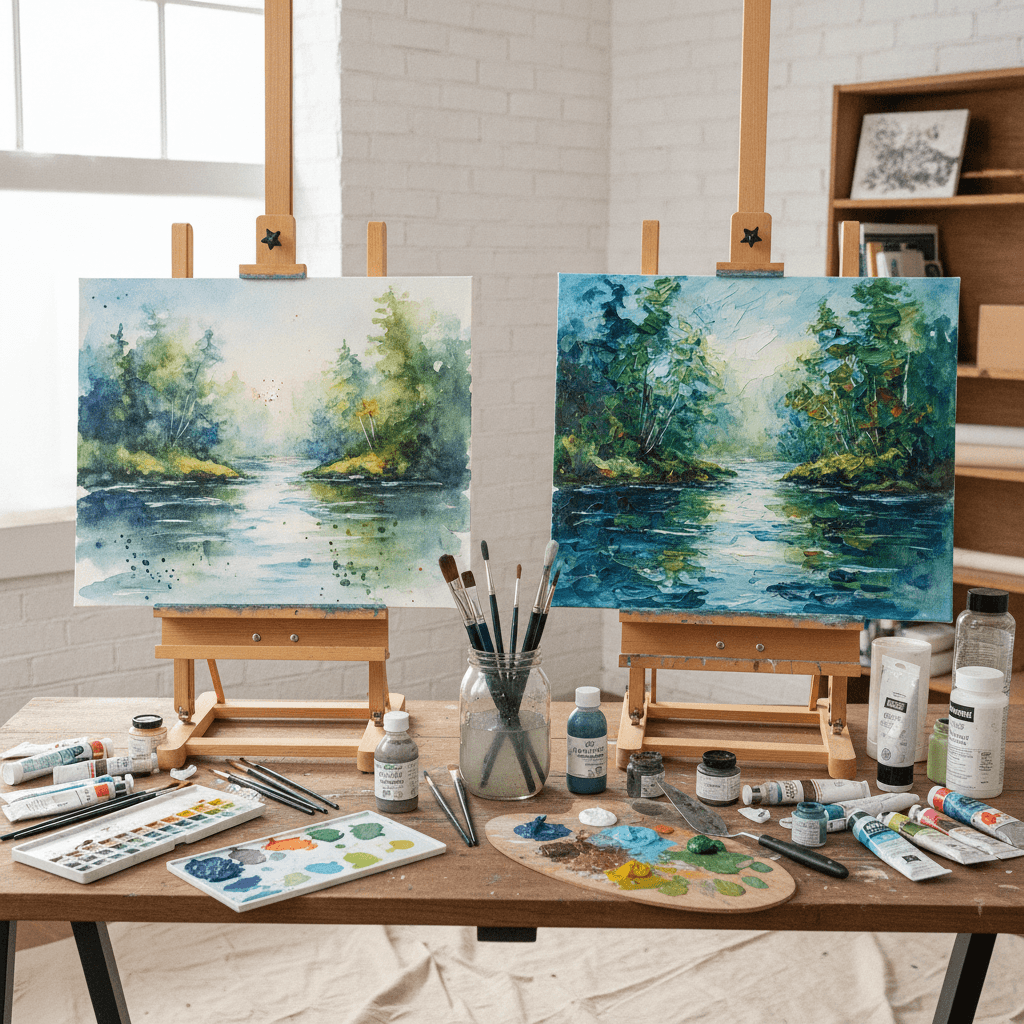
The beginner's first question — watercolor or acrylic — doesn't have a universal answer, but it does have a *personal* one. The mediums reward different temperaments and different goals. Here's the actual comparison (including the personality fit that nobody usually mentions), so you can start with the right paint for you.
The Quick Comparison
Watercolor:
- Startup cost: ~$30
- Learning curve: steep first month, then long gentle improvement
- Forgiveness: low mid-painting (mistakes are visible), high overall (it's just paper)
- Cleanup: water only; the easiest
- Portability: the best — a sandwich-size kit paints anywhere
- Aesthetic: luminous, atmospheric, transparent
Acrylic:
- Startup cost: ~$40
- Learning curve: gentler at first ('opaque covers mistakes'), similar long-term arc
- Forgiveness: HIGH mid-painting — dry paint is paint-over-able
- Cleanup: water while wet (soap if dry); easy
- Portability: fine
- Aesthetic: bold, opaque, flexible finish (matte or gloss)
The Temperament Fit (The Real Question)
The medium picks you by temperament:
- If you're patient, like subtlety, enjoy letting go of control, and respond to quiet elegance: watercolor. The medium rewards a personality at peace with impermanence — the pigment moves, and you negotiate with it.
- If you like boldness, want to be able to fix things mid-process, respond to saturated colors, and prefer a more deliberate 'I'm making a thing' experience: acrylic. The medium is a teammate, not a negotiation.
Wrong matches are survivable but frustrating. Self-knowledge here saves you a starter-kit purchase on the wrong side of the fence.
The Skill Transfer Reality
Skills transfer across mediums less than beginners expect: watercolor teaches you edge control and value-thinking through its transparency; acrylic teaches you layering and opacity-thinking. Artists who work in both describe complementary skill sets, not a hierarchy. If you're torn: start with the one that sounds more fun *to you*. You'll likely try the other within a year anyway — the mediums share enough fundamentals (color theory, composition, brush handling) that the second one is easier.
Starter Shopping Lists (Both, Because You'll Want Both)
Watercolor starter (~$30):
- 12–24 pan student watercolor set
- 2 round brushes (6 and 10)
- 140lb cold-press watercolor paper pad
- 2 water cups, paper towels
Acrylic starter (~$40):
- 5–6 tubes (titanium white, carbon black, ultramarine, cadmium yellow, crimson, burnt sienna)
- 3 brushes (large flat, medium flat, small round)
- Canvas pad or 3 small stretched canvases
- Palette (paper plate works permanently)
Both fit a small bag; both are the kit for the first year. Beyond this list the spending is optional, not necessary.
What Each Medium Feels Like at Month 3
Honest preview:
- Watercolor at month 3: occasional luminous 'happy accidents,' slowly learning water control, still fighting muddy colors but less, producing a few small pieces you're proud of, learning that the paper was often the problem
- Acrylic at month 3: bold paintings with satisfying coverage, learning when to stop (the medium rewards restraint as you learn), comfortable with layering, occasionally frustrated by fast drying on warm days
Both are good places to be. They're different kinds of good, and the personality that made you pick is the one enjoying the ride.
Our House Opinion (If We Had to Pick One)
For beginners from a studio-teaching perspective: we teach acrylic at paint nights because the opaque, fixable nature accommodates a wide range of confidence levels in a social setting. For solo home practice by someone who self-identifies as detail-oriented or quiet-aesthetic-loving: watercolor is the recommendation. But the truth we genuinely believe: pick the one that makes you want to paint *tonight*, not the one that sounds more serious. The medium you'd actually use beats the medium with the better case.
Either medium, the rule is the same: start. Then if acrylic is your pick, see you at a paint night — we'll supply the canvas, you supply the showing up.