Why Creative Hobbies Reduce Stress: What the Research Actually Says
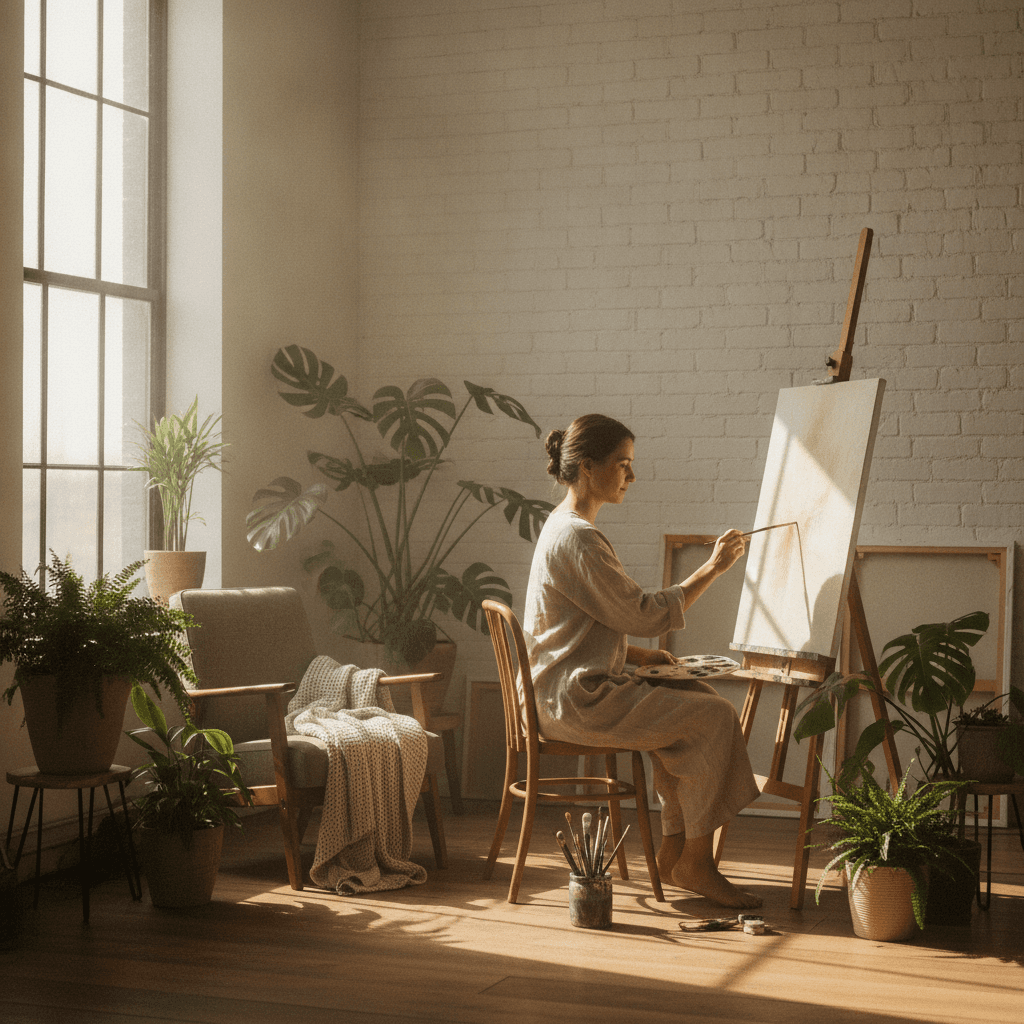
You don't need a study to tell you that an evening of painting beats an evening of doom-scrolling — but the studies exist anyway, and they're more interesting than you'd expect. Creative hobbies measurably change stress chemistry, and understanding *why* helps you get more of the benefit. Here's what the research says, minus the jargon.
The Flow State: Your Brain's Off-Ramp From Worry
Psychologist Mihaly Csikszentmihalyi spent decades studying "flow" — the absorbed state where you lose track of time. Creative activities are flow factories because they hit the required conditions: a clear goal (finish the canvas), immediate feedback (the stroke either worked or didn't), and a challenge just above your skill level. During flow, the brain's default mode network — the circuitry that runs rumination and worry — quiets down. That's the mechanism behind "I looked up and two hours had passed and I hadn't thought about my inbox once."
The Cortisol Evidence
A much-cited 2016 study from Drexel University measured cortisol (the primary stress hormone) in participants before and after 45 minutes of art-making. Cortisol dropped in roughly 75% of participants — and here's the part we love: prior art experience had no relationship to the benefit. Skill was irrelevant; making was everything. This validates what every paint-night instructor knows intuitively: the person who insists they "can't paint" gets just as much out of the evening as the practiced hobbyist. Studies of baking and cooking show parallel results — structured, sensory, hands-on tasks reliably lower self-reported anxiety.
Why Hands Matter Specifically
There's a growing thread of research on what neuroscientist Kelly Lambert calls "effort-driven rewards" — the idea that work done with your hands, producing a tangible result, activates reward circuitry more robustly than passive consumption. Kneading, piping, brushwork, and whisking all qualify. It's an evolutionary argument: our brains were built to feel good when we make useful physical things. A screen can't give you that loop. A palette knife can.
The Social Multiplier
Solo creative time works, but making things *with people* stacks a second benefit on top. Group art activities add belonging, laughter, and shared vulnerability — everyone's bad first brushstroke is a tiny trust exercise. This is exactly the architecture of a paint and sip night: structured creativity plus low-stakes socializing plus a drink. It's a stress-reduction trifecta dressed up as a night out.
How to Actually Build the Habit
The research means nothing if the hobby stays aspirational. What works:
- Make it tiny: 20 minutes twice a week beats a heroic monthly marathon
- Attach it to an existing habit: sketch while coffee brews, pipe frosting while the podcast plays
- Remove the setup friction: a dedicated corner with supplies visible gets used; a box in a closet doesn't
- Schedule social versions: a booked class is an appointment you'll keep in a way "I should paint more" isn't
- Drop the quality bar: the stress benefit doesn't care what the thing looks like. The imperfect painting still lowered your cortisol.
The Bakery Angle (Of Course There Is One)
Baking sits at a specific sweet spot in this research: it's creative, tactile, time-bounded, sensory (smell is the most memory-linked sense), and it ends with generosity built in — you make something for people. The bakers among our customers consistently describe the same loop: a hard week, a weekend bake, the calm of measured steps, and the disproportionate joy of handing someone a box of something you made. If that sounds like a prescription, it kind of is. And if you want the joy shortcut, making it together at an event or class compresses the whole loop into one evening.
Your stress doesn't need another app. It needs flour on your hands or paint on your knuckles — and we've got both: browse the shop or book a paint night.